
Health Director Iulia Vann joins Pitt Public Health’s Health Policy and Management Department
Allegheny County Health Director Iulia Vann, MD, MPH, has been appointed adjunct associate professor of health policy and management at Pitt’s School of Public Health, as part of a previously announced partnership between the Allegheny County Health Department and the school to create an academic public health department.
HPM team takes podium finish at Seton Hall case competition
A year after a double podium finish, an HPM team was back on the podium at the Seton Hall case competition.
The team of first-year MHA student Michaela Frey and first-year MHA/MBA student Ella Valencia came back from New Jersey with a third-place finish.

Mayor and Pitt alumna Alyia Gaskins’ healthy outlook
Long before the meetings, community events and the shifting demands of city leadership begin, Mayor Alyia Gaskins (HPM ‘11) starts her day with the same awareness that has guided her since childhood: health shapes every moment. For Gaskins, now the first Black woman to serve as mayor of Alexandria, Va., health has never been confined to the doctor’s office. It is rooted in the places we live, the food we eat, the stress we carry and the systems that shape our daily lives.

The business of caring for older Americans is in a deepening crisis
According to a 2025 study, older adults in need of assistance were 5 percent less likely to get home care after a significantly lower cap on refugee admissions this year. Amanda Kreider, study co-author and assistant professor of health policy and management professor at the School of Public Health, says the findings reflect "chilling effects." (Subscriber content.)
2025 Public Health Practice Showcase
The 2025 Public Health Practice Showcase featured 15 graduate students representing each of Pitt Public Health’s seven departments, who presented work done in collaboration with community partners. Awards were also presented to faculty, staff and community partners who exemplify public health practice excellence.
In her opening remarks, Dean Lichtveld spoke of the importance of “making sure our science works for communities. Otherwise, our science doesn’t work.”

In Memoriam: Patricia Maryland, DrPH
Patricia A. Maryland, DrPH, a 1982 Pitt alumna, died October 24, 2025 at 72. Before earning her doctorate in public health from the Department of Health Services Administration (predecessor to Health Policy and Management), Maryland earned her bachelor’s in applied mathematics from Alabama State University and a master’s in biostatistics from the University of California—Berkeley.
AI could make it harder to establish blame for medical failings, experts say
Professor of Health Policy and Management Derek Angus, MD, MPH, said it was important that funding was made available for the performance of AI tools in healthcare to be properly assessed, with investment in digital infrastructure a key area. “One of the things that came up during the summit was [that] the tools that are best evaluated have been least adopted. The tools that are most adopted have been least evaluated.”

Christine McClure received a Distinguished Alumni Award from Point Park University
Christine McClure, a senior research scientist in the Department of Health Policy and Management, was honored with a 2025 Distinguished Alumni Award from her alma mater Point Park University.
Map shows highest health insurance premium rises by US state
Coleman Drake, a professor in the Department of Health Policy and Management at the University of Pittsburgh, told Newsweek that "increases in premiums caused by the expiration of enhanced subsidies will cause millions of marketplace enrollees to become uninsured because they will no longer be able to afford health insurance. These coverage losses will be largest among lower income enrollees, as they are the most sensitive and vulnerable to premium increases."
COVID-19 vaccination: Pitt Public Health experts answer your questions
Although the federal public health emergency ended in 2023, COVID-19 continues to evolve and affect health worldwide. The virus remains part of our daily lives and still poses risks, especially for people vulnerable to severe illness. Vaccination remains a key tool for protecting individuals and communities, much like with influenza.
Pitt studies highlight access to treatment in a Health Affairs special issue on Opioid Use Disorder
In a themed issue on the opioid crisis published in Health Affairs, three studies from University of Pittsburgh School of Public Health researchers underscore gaps in access to methadone, a medication that can reduce the risk of overdose-related deaths by 50% or more, and other evidence-based interventions.
ADHD drugmakers double marketing spending to clinicians
“What stood out in our findings was the increasing role of marketing payments directed toward advanced practice clinicians,” said J. Travis Donahoe, PhD, MPH, assistant professor of health policy and management at the University of Pittsburgh School of Public Health and the lead author of the study.
HPM researchers are focusing on burdens that keep people from insurance coverage and health care
In 2023, it was estimated that 26 million Americans, or 8 percent of the population, lacked health insurance. That number has been halved from the 49 million who lacked insurance before the Affordable Care Act. Substantial barriers to coverage and care remain, even with more affordable plans and options.
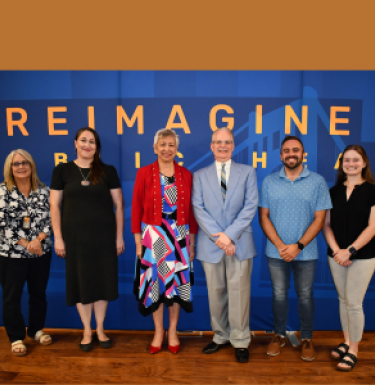
Pitt Public Health staff shine
Pitt Public Health recently presented the inaugural Staff Awards, honoring exceptional effort and dedication through teamwork, leadership, innovation and contribution to school, University and community culture. The awards were presented on August 5 at the annual Staff Recognition Picnic, preceded this year by a ceremony that also recognized staff who reached milestone service anniversaries in the last fiscal year. The event also celebrated the hard work of the entirety of the school’s staff.